
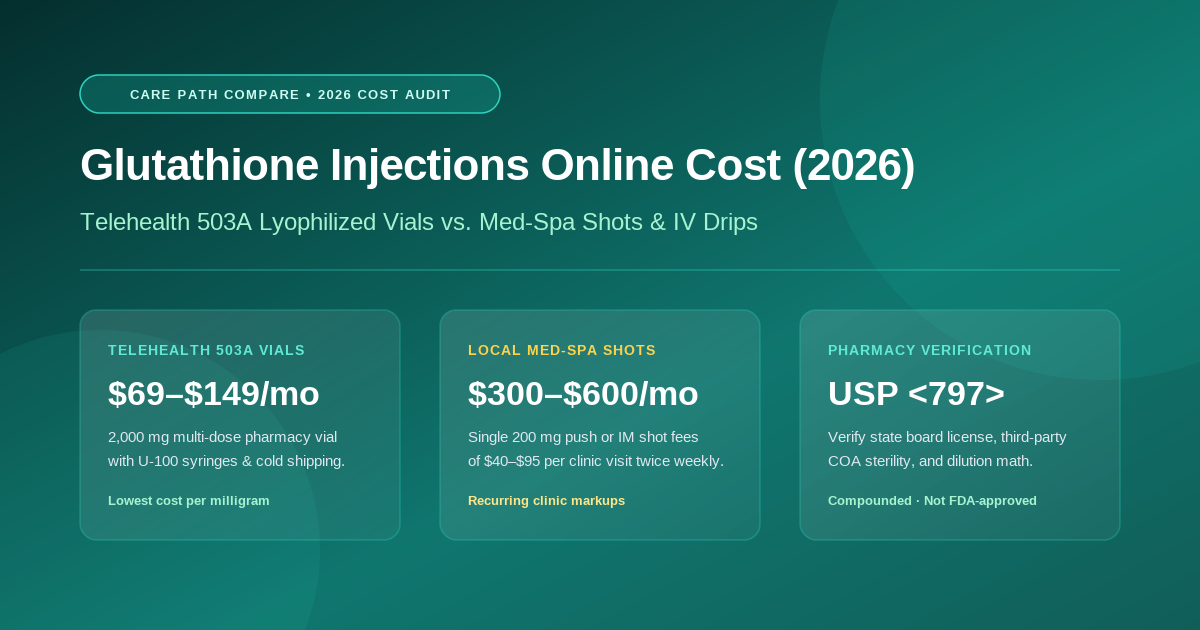
2026 cost comparison: Telehealth 503A vials vs. med-spa shots vs. IV drips
In-person longevity bars charge per clinic chair visit rather than per milligram of active antioxidant. When a prescribing physician approves home subcutaneous (SubQ) or intramuscular (IM) administration through a telehealth platform, your cost drops sharply because one sterile multi-dose vial covers multiple weeks of prescribed doses.
| Fulfillment channel | Typical advertised outlay | Supply covered | Estimated monthly run-rate | Key tradeoffs to audit |
|---|---|---|---|---|
| System Labs (503A Telehealth) | $69–$109 intro display ($133–$149 reference) | 2,000 mg vial (monthly vs. quarterly page discrepancy) | ~$69–$149 / shipment | Check page-specific billing interval; auto-refills apply |
| Collective (Telehealth Platform) | $59–$69 starter framework + $199/yr membership after 21-day trial | Asynchronous medical evaluation + 503A fulfillment | Depends on treatment selected | Verify current wellness peptide availability in your state |
| Local Med-Spa Push Shots | $40–$95 per clinic injection | Single 200 mg push or IM dose | $320–$760 / mo (2x weekly) | Clinic commute, provider injection fee, zero multi-dose efficiency |
| IV Longevity Lounges | $175–$350 per IV drip add-on or session | Single high-dose infusion | $350–$1,200+ / mo | Steep markup per milligram; vein irritation or infusion reactions |
Note on System Labs Glutathione pricing: Our verified System Labs Glutathione review documented conflicting promotional prices across official System Labs URLs ($69 treatment page, $79 dedicated landing page, $89 catalog, $99 company page, and $109 homepage), plus a monthly vs. quarterly duration discrepancy on the 2,000 mg vial. Always screenshot the final checkout summary showing renewal date, renewal dollar amount, and vial refill frequency before paying.
What drives real per-milligram cost in online glutathione prescriptions?
Two patients quoted “$99/month” for injectable glutathione can end up paying double the cost per milligram once pharmacy concentration and dosing cadence are factored in:
- Vial potency and total milligrams (1,000 mg vs. 2,000 mg vs. 4,000 mg): A $133 refill covering a 2,000 mg vial equals $0.0665 per mg, whereas an $89 single 1,000 mg vial costs $0.089 per mg—plus an extra shipping or refill fee cycle.
- Monthly vs. quarterly shipment labeling: If a clinic divides 2,000 mg across twice-weekly 200 mg doses (400 mg/week), the vial lasts roughly 5 weeks—not a full 90-day quarter. By contrast, micro-dosing 100 mg twice weekly (200 mg/week) extends 2,000 mg to 10 weeks. Check exact U-100 insulin syringe tick marks printed on your pharmacy carton using our educational Peptide Reconstitution Calculator.
- Included sterile supplies and cold-chain transit: Reputable telehealth dispensaries bundle bacteriostatic water (when lyophilized), sterile U-100 insulin syringes, alcohol prep pads, and insulated two-day refrigerant shipping in the quoted checkout total rather than tacking on $25–$45 supply kits at checkout.
- Separate membership dues: Watch for clinics quoting low medication rates alongside mandatory $49 to $99 monthly platform memberships or non-refundable consultation charges when clinically ineligible. Compare recurring contract rules in our GLP-1 and telehealth cancellation policy guide.
Lyophilized vials vs. pre-mixed glutathione & nasal sprays
Glutathione degrades rapidly through oxidation when exposed to heat or extended storage in aqueous solution:
- Lyophilized (freeze-dried) sterile vials: Shipped as a dry crystalline cake alongside sterile bacteriostatic water for reconstitution prior to first use. Lyophilized storage generally preserves peptide stability better during multi-day warm-weather parcel transit than unrefrigerated pre-mixed liquid vials.
- Pre-mixed refrigerated solutions: Ready to draw immediately upon arrival, but strictly require uninterrupted cold-chain shipping, immediate home refrigeration, and tighter beyond-use dates (BUD) under USP <797> sterile compounding limits.
- Oral & nasal alternatives: Standard oral glutathione capsules undergo enzymatic breakdown in the gastrointestinal tract and first-pass liver metabolism. Compounded intranasal sprays (for example, System Labs lists nasal spray options around $79 first month / $169 reference) avoid needles, but clinical bioavailability and dosing kinetics differ substantially from parenteral SubQ/IM injections.
503A compounding pharmacy checks before ordering online
Because injectable glutathione is dispensed as a patient-specific compounded medication rather than an FDA-approved commercial brand, patients should verify every pharmacy disclosure carefully:
- Verify the named 503A facility on the privacy policy or checkout screen: For instance, System Labs’ legal disclosures identify The Pharmacy Hub in Miami, Florida as a dispensing partner, though patients should confirm the exact pharmacy printed on their own prescription label.
- Confirm active state board licensure and non-resident permits: Use your state board of pharmacy lookup portal via our 503A Compounding Pharmacy Telehealth Directory and 503A verification checklist.
- Ask about third-party Certificates of Analysis (COA): Confirm potency verification, USP <71> sterility testing, and USP <85> bacterial endotoxin screening—especially when comparing higher-dose peptide vendors like System Labs against alternatives in our System Labs main review and NAD+ injections cost guide.
- Clarify FDA non-approval and refund finality: Compounded injectables cannot legally claim FDA approval, and customized pharmacy orders generally become non-refundable once compounded or dispatched.
Bottom line: How to avoid overpaying for glutathione injections
If you are considering physician-supervised injectable glutathione in 2026, skip per-visit med-spa push markups ($300–$600+/mo) and evaluate licensed telehealth 503A pharmacies that clearly disclose total vial milligrams, included sterile supplies, and cold-chain transit. Always audit the checkout screen for exact renewal frequency before submitting payment, and cross-check related cellular longevity guides covering NAD+ injections vs. IV therapy and Sermorelin subcutaneous vs. troches costs.